
Research Highlights
What could we learn from 1000 secondary eclipses with Roman?
Roman’s Galactic Bulge Time Domain Survey could detect the secondary eclipses of 1000 hot Jupiters. This would be the largest ever dataset of its kind. I’m interested in using large simulations to predict how well this dataset could answer open questions about the physics and chemistry of hot Jupiter atmospheres.
In prep. See a recent poster on this work here.
How are sub-Neptune atmospheres affected by stellar host type?
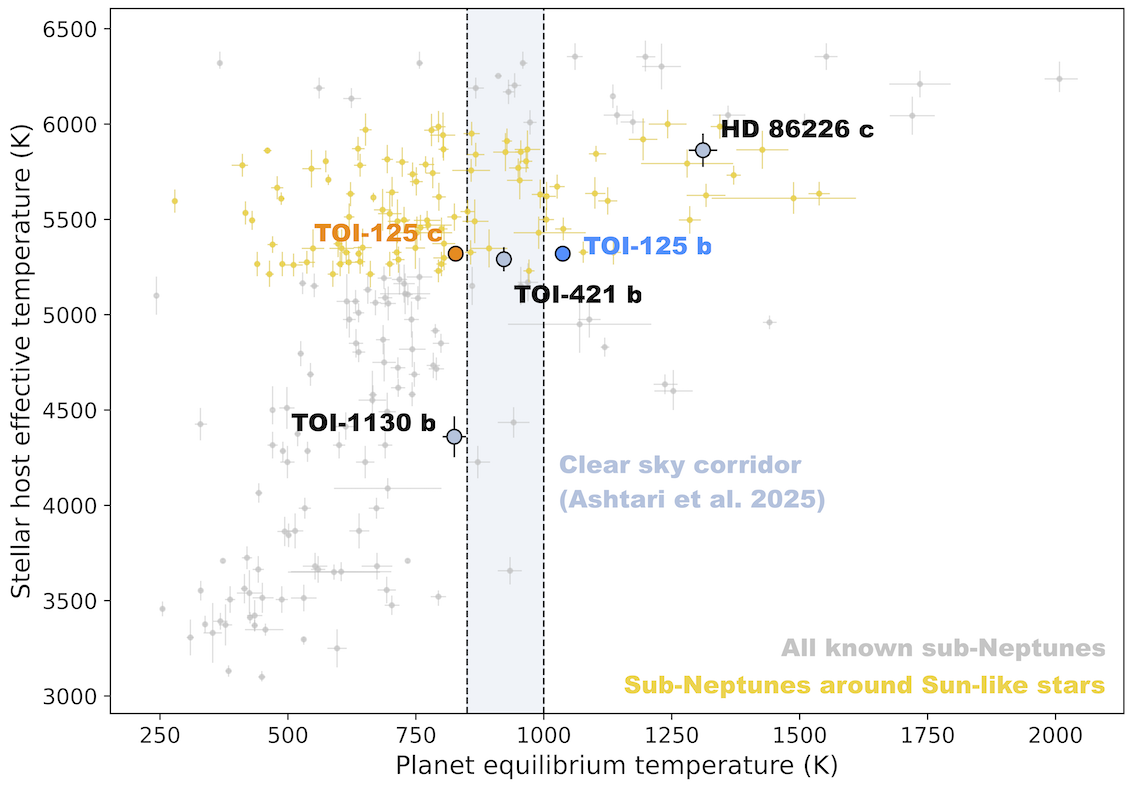
The Kepler mission revealed that planets between Earth and Neptune in size are among the most common in our Galaxy — but we don’t have one in our own solar system. Uncovering the nature and origin of this mysterious class of planets can help us better understand how planet formation works and place our solar system into context. Previous observations of sub-Neptunes around cooler M- and K-type stars have hinted at a diversity of atmospheric conditions that may vary with planet temperature. However, very few sub-Neptunes around stars like our sun have been observed — and the ones that have definitely complicate the picture. I used JWST to investigate the atmospheres of two hot sub-Neptunes orbiting a sun-like star and test whether they follow a temperature-dependent trend.
Under review.
The dynamics of young systems can hint at the presence of undetected planets
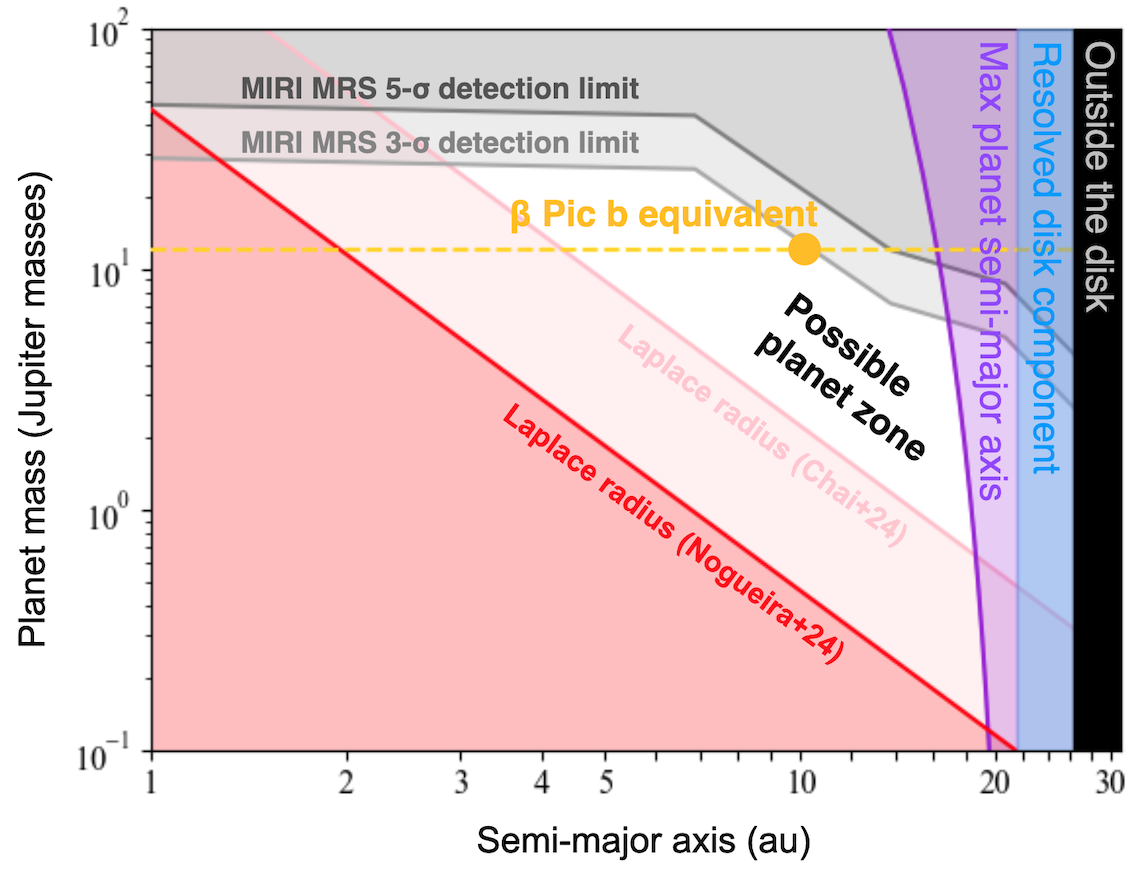
I used observations from JWST to investigate the debris disk around the young star eta Telescopii (eta Tel) and its brown dwarf companion, eta Tel B. I found a previously unidentified silicate feature, and used 25 years of observations to study the companion’s orbit. Surprisingly, the disk appears largely symmetrical despite the companion’s expected gravitational influence. I explored whether an additional, currently undetected planet interior to the debris disk could counteract the perturbations from the outer brown dwarf. Combining constraints from the disk morphology, companion orbit, JWST detection limits, and dynamical stability arguments, I identified a plausible parameter space for an unseen planetary perturber of approximately 0.7-30 Jupiter masses at ~3-19 au. Although this is a hypothesis rather than a detection, it demonstrates how spatially resolved debris disks can act as indirect probes of planetary architectures that are otherwise difficult to observe.
Read the paper here.